Brought to life by writer Leah Williams, artist Filipe Andrade, and with a cover by Jeff Dekal, Illyana Rasputin enters a new reality on October 31.
Before she was Magik, Illyana was just a kid whom Limbo
chewed up and spit out seven years older. So it’s no surprise that, at
15, she wants nothing to do with the X-Men…nothing to do with the New
Mutants…and nothing to do with her own powers. It’s not even
surprising that she runs away…but where—and who—she ends up? Well,
that’s something you’ve never seen before.
“Illyana Rasputin deserves better,” explains book editor Annalise Bissa. “As
much as we all love a character who’s been aged up, down, grown up
under the thumb of demons, watched her parents die, died herself, come
back, been evil, been good again, had more power changes than you can
shake a stick at…any X-Fan might start to wonder who Magik would be in
a world where her mutation isn’t ruled by these crazy ups and
downs—where she has the chance to embrace her power early and grow from
there, this is the book for you. If you like Magik, magic, or any other
word for all things mystical and mysterious and maybe a little bit
murderous, read WHAT IF? MAGIK #1.”
Holy hell, but that is some cover.
Do yourself (and me) a favor. Pre-order this. I doubt shops will order big on these oneshots and you might not find it otherwise. More importantly: Marvel is putting out a solo Illyana book. This is a oneshot. But if it does decently, you can bet your soulsword it will make them consider putting her name on more.
Bonus: Interior art by Felipe Andrade of Secret Wars: Siege (aka Leah and Illyana Eloping Spectacular) fame!
To whet our appetite a little more, some insight into the thoughts of the writer:
Andrade is a terrible artist but damn, an Illyana solo! Finally!! And lol, the name of the writer is funny haha
We believe it is of utmost importance for users to have control of their content and how it is accessed. Tumblr’s structure encourages users to think of other people’s content that they reblog as partially their own, but we think that that mentality leads to a lot of the harassment and plain rudeness that has grown on Tumblr over the years. The fact that a post can be reblogged by others, ridiculed, and passed around endlessly after the original user has already decided they don’t want that content to exist and represent them anymore has always struck us as a massive design flaw. On Pillowfort a user’s post is always their post first and foremost, and all reblogs and comments to that post are still under the control of the original user. So yes, while it may be unfortunate to have a post you like disappear from your blog or lose a comment you left, we think it is still more important for a user to be able to delete their own content when they choose.
I can’t think of any benefits to non-destructible reblogs that is worth having a
user’s control over access to their own content taken away.
It’s worth noting that users can also delete any individual comments left on their post, because we want to encourage the notion that when you comment on someone’s post you are in THEIR space. It’s a bit of a shift from the way that Tumblr and Twitter have forced users to deal with anyone and everyone putting their own thoughts on your content, but we don’t think users should have to deal with the responses of people who may only be trying to spread harassment or otherwise exploit users’ lack of control over responses to act in bad faith, as we have all seen happen quite often.
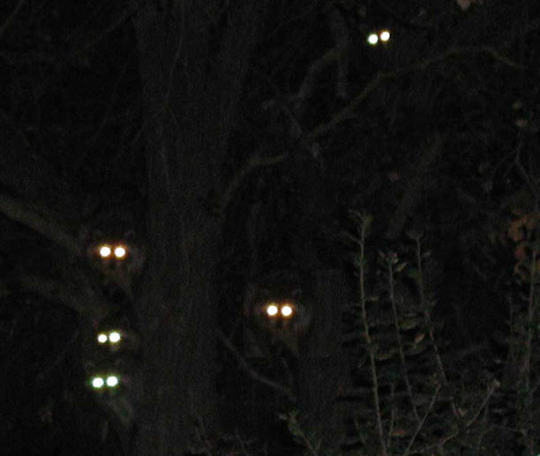
also consider: LOTR but hobbits have Tapeta Lucidum
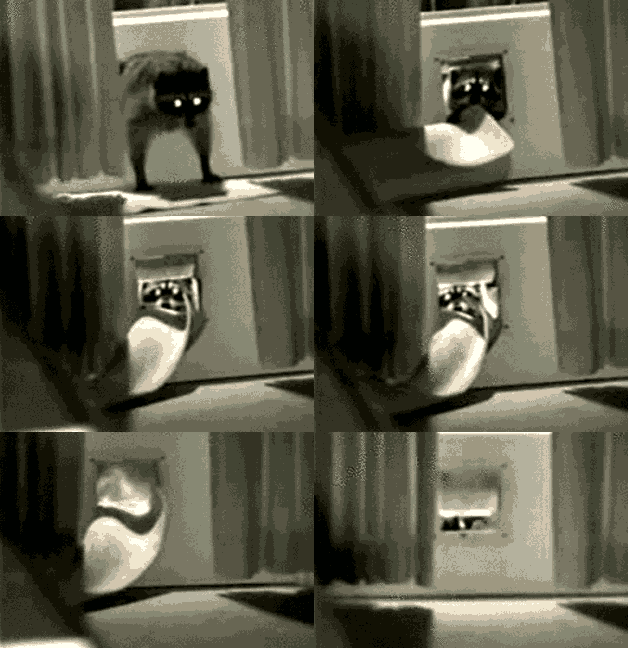
Boromir gets the fright of his life their first night on the road
Boromir: *glances over his shoulder* ??!!!!???!!
Hobbits:
Hobbits: what
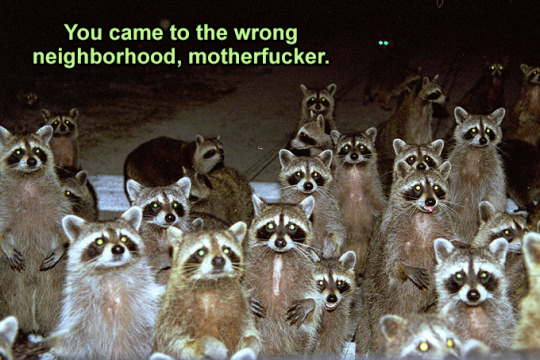
i will never get over that you used an image of raccoons for this purpose because it is incredibly accurate
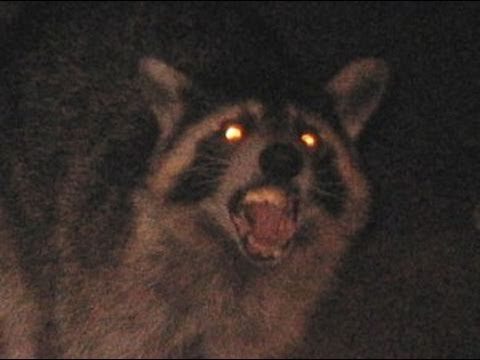
LOTR au but instead of hobbits literally raccoons
Gandalf: well this raccoon found the ring and has been carrying it around. unfortunately we can’t take it off him or he gets very bite-y. so I figure, the raccoon is the ringbearer now
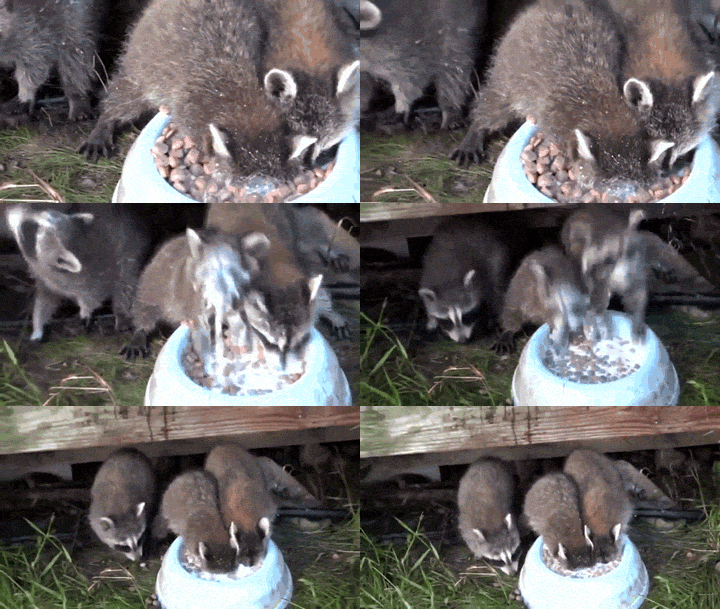
Elrond: what are those other three raccoons doing here
Gandalf: he brought his buddies. I call this one ‘Merry’
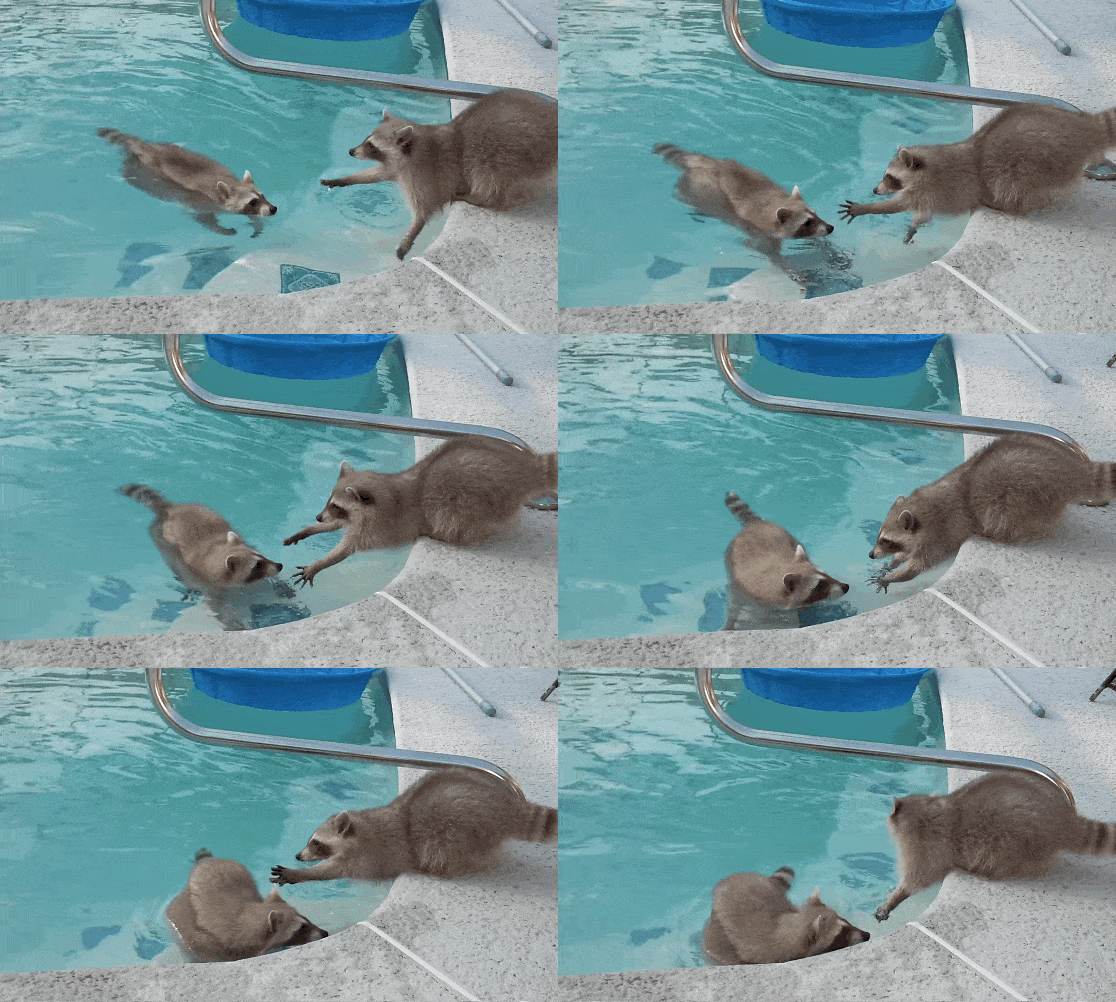
Aragorn: *watching Frodo & Sam scamper off in the direction of Mordor* our hopes lie with those raccoons now
Legolas: do they… know where they are going
Aragorn: I sure hope so
Faramir: father why is this raccoon in the livery of the citadel
Denethor: haha doesn’t he look precious
Elfhelm: Dernhelm, is that a raccoon in your bag?
Dernhelm: *sweating nervously* Uh no, sir.
Eowyn, later: And I said no, you know, like a liar.
Denethor: WHY did you let a raccoon go off with the Ring??
Faramir: ….it just seemed like the right thing to do
Gandalf: he scratched you up real good huh
Faramir: ……………gouged my FUCKING arm and bit me on my face
Witch King: no living man can kill me – AUGH FUCK, RACCOON, RACCOON ON MY LEG ARGHHHH
Eowyn: *stab*
Wraiths break into the room at the prancing pony: *UnHoLy ScReEcHiNg*
Trash Panda Hobbits:
Wraiths: Oh, what the fuck, whAT THE FUCK IS THAT?!
Treebeard: Baroom, humm, where are my small, impatient friends?
Merry and Pippin:
Don’t go where I can’t follow, Mr. Frodo.
~~~~~~The Hobbit interlude~~~~~~
Thorin:
You’re the burgular.Go on and…burgle something! Bilbo:
Saruman: Well since some fucking TREES took over Isengard I guess I’ll take over The Shire. Farmer Maggot and ever other Halfling down to the Sacksville-Bagginses:
If you’ve been on the internet today, you’ve probably interacted with a neural network. They’re a type of machine learning algorithm that’s used for everything from language translation to finance modeling. One of their specialties is image recognition. Several companies – including Google, Microsoft, IBM, and Facebook – have their own algorithms for labeling photos. But image recognition algorithms can make really bizarre mistakes.
It also tagged sheep in this image. I happen to know there were sheep nearby. But none actually present.
Here’s one more example. In fact, the neural network hallucinated sheep every time it saw a landscape of this type. What’s going on here?
The way neural networks learn is by looking at lots of examples. In this case, its trainers gave it lots of images that humans had labeled by hand – and lots of those images contained sheep. Starting with no knowledge at all of what it was seeing, the neural network had to make up rules about which images should be labeled “sheep”. And it looks like it hasn’t realized that “sheep” means the actual animal, not just a sort of treeless grassiness. (Similarly, it labeled the second image with “rainbow” likely because it was wet and rainy, not realizing that the band of colors is essential).
Are neural networks just hyper-vigilant, finding sheep everywhere? No, as it turns out. They only see sheep where they expect to see them. They can find sheep easily in fields and mountainsides, but as soon as sheep start showing up in weird places, it becomes obvious how much the algorithms rely on guessing and probabilities.
Bring sheep indoors, and they’re labeled as cats. Pick up a sheep (or a goat) in your arms, and they’re labeled as dogs.
Paint them orange, and they become flowers.
Put the sheep on leashes, and they’re labeled as dogs. Put them in cars, and they’re dogs or cats. If they’re in the water, they could end up being labeled as birds or even polar bears.
And if goats climb trees, they become birds. Or possibly giraffes. (It turns out that Microsoft Azure is somewhat notorious for seeing giraffes everywhere due to a rumored overabundance of giraffes in the original dataset)
The thing is, neural networks match patterns. They see patches of furlike texture, a bunch of green, and conclude that there are sheep. If they see fur and kitchen shapes, it may conclude instead that there are cats.
If life plays by the rules, image recognition works well. But as soon as people – or sheep – do something unexpected, the algorithms show their weaknesses.
Want to sneak something past a neural network? In a delightfully cyberpunk twist, surrealism might be the answer. Maybe future secret agents will dress in chicken costumes, or drive cow-spotted cars.
And you can test Microsoft Azure’s image recognition API and see for yourself that even top-notch algorithms are relying on probability and luck. Another algorithm, NeuralTalk2, is the one I mostly used for the Twitter thread.




 Tsarina Jissa's Tumblr