“What sort of comedian can’t even make the lesbians laugh?” the Australian comedian Hannah Gadsby asks in her new Netflix standup special, “Nanette.” “Every comedian ever,” she answers, grinning conspiratorially, her eyebrows darting behind horn-rim glasses. “The only people who don’t think it’s funny are us lezzes, but we’ve gotta laugh, because if we don’t—proves the point!” It’s a good joke, knowing and playful in the style that Gadsby, a star in her home country, has built her comedy career on. But it also contains a seed of discomfort: the image of the hypothetical gay woman in the audience, not quite comfortable with the joke, but being conscripted into laughing anyway, at her own expense.
This gesture is intentional. “Nanette,” Gadsby’s first foray into the American mainstream, begins as a traditional comedy show in the autobiographical, self-deprecating vein of the comedian’s older work. Gadsby is a native of Tasmania, Australia’s rural southern island state, where, when she was growing up, the majority of Tasmanians believed that homosexuality should be a criminal offense. She jokes about coming out to her mom and being mistaken for a man in public because of her butch appearance. One time, a cashier was mortified after calling her “sir.” Another time, a drunk guy at a bar threatened to beat her up when he saw her hitting on his girlfriend, only to apologize when he realized that she was a woman.
But in the course of the hour-long set, which was filmed at the Sydney Opera House (Gadsby has also been performing at the SoHo Playhouse, in New York), “Nanette” transforms into a commentary on comedy itself—on what it conceals, and on how it can force the marginalized to partake in their own humiliation. Gadsby, who once considered Bill Cosby her favorite comedian, now plans to quit comedy altogether, she says, because she can’t bring herself to participate in that humiliation anymore. Onstage, Gadsby typically speaks in a shy, almost surprised tone, playing jokes off of an unassuming, nebbishy demeanor. She clutches the mic with two fists and speaks softly, forcing audiences to listen closely to hear her. In “Nanette,” she seems to slowly shed that persona, becoming increasingly assertive and, at times, deadly serious. Her set builds to include more and more disturbing accounts of her own experiences with homophobia and sexual assault, and broader themes of violence against women and male impunity. But for every moment of tension, Gadsby gives her crowd release in a punch line—until she doesn’t. When the jokes stop, the audience is forced to linger in its unease. “This tension? It’s yours,” she says at one particularly upsetting moment, toward the end of the show. “I am not helping you anymore.”
Gadsby’s moving anti-comedy in “Nanette” has been compared to Tig Notaro’s set, in 2012, about having breast cancer and her grief at the recent death of her mother, and how the two catastrophes had compounded each other in her life. Both shows challenge audiences to think about the comedian not just as a performer but as a person capable of pain. But where Notaro’s set felt intimate and immediate—it was delivered just days after her diagnosis—Gadsby’s material is almost two years in the making and seems to harness the broader fury of the #MeToo moment. Gadsby, like many women, is done hiding her anger, and in “Nanette” she bends the bounds of standup to accommodate it.
Gadsby holds an art-history degree, and at one point in her show she shifts to discussing the lives of famous artists. “I hate Picasso,” she says, “but you’re not allowed to.” In his forties, the painter—married, famous, and at the height of his artistic career—carried on an affair with a teen-age girl named Marie-Thérèse Walter. “Does it matter?” Gadsby asks. “Yeah, it does matter.” Picasso later said of his affair with Walter, “It was perfect. I was in my prime, she was in her prime.” Gadsby goes on to explain the obvious, that no girl is in her prime in her teen years; to Picasso, a woman’s prime was nothing more than the prime of her attractiveness to him. Picasso was the founder of Cubism, the artistic movement that allowed multiple perspectives to be simultaneously represented on a canvas. “Any of those perspectives a woman’s?” Gadsby asks. Art, she makes clear—from painting to comedy—does not liberate everyone equally. It can replicate the same privileges and exclusions as the culture in which it was made.
In the world of standup, this is, in part, a problem of form. In the show, Gadsby explains that a joke, at its core, has two components, a set-up and a punch line. Stories, meanwhile, have three parts: a beginning, a middle, and an end. Gadsby thinks that there is harm in the joke’s tendency to truncate a story; the ending is the place where understandings can be expanded and lessons learned. “That’s where catharsis lives,” she said, in an interview with Emily Nussbaum on The New Yorker Radio Hour. “That’s where hindsight lives.” Telling a joke, by contrast, means leaving things out—cutting down on complexity, context, and moral stakes. For Gadsby, excising these for the sake of making people laugh has become too great a sacrifice.
One of comedy’s most effective tools is something known as a callback, wherein a story or a bit from earlier in a set is mentioned again later, and the repetition amplifies the joke’s effect. A callback helps to establish a rapport between the comedian and the audience; now they’re in on the joke together. In “Nanette,” Gadsby subverts this technique to devastating effect, returning to the story of the man who threatened her for flirting with his girlfriend outside a pub, only to back off when he realizes that she was a woman. When the story ends there, it’s funny—it’s a joke about the man’s ignorance. But the second time Gadsby recounts this, she tells us that the man in fact came back to her after he walked away, realizing his mistake. “I get it. You’re a lady faggot,” he told her. “I’m allowed to beat the shit out of you.” And he did. No one stopped the man from beating her, she says. She never reported the attack to the police, and, even though she was injured, she never took herself to the hospital. Recounting this, Gadsby’s eyes redden; her voice is loud and breaking. She points one hand emphatically outward, as if implicating the whole world in failing to protect her.
Watching Gadsby, it was impossible not to think of the many women who’ve come forward in recent months with stories of abuse that were years or even decades old. You could consider the #MeToo moment itself as a kind of callback, a collective return to stories that women have been telling one way—to others, to themselves—with a new, emboldened understanding that those past tellings had been inadequate. Like Gadsby, many women have excluded or elided the difficult parts of their stories for the sake of a punch line, the sake of not upsetting the status quo, or the sake of the comfort of their listeners. For many others, the #MeToo moment was not the first time they had spoken out; it was only the first time that they were listened to. Perhaps this is the most vital way in which “Nanette” reflects the events of the past year. In her interview with Nussbaum, Gadsby recounts that when she first began performing the show, she would be heckled by members of the audience—always by men, always at the point when she revealed that she had been sexually assaulted. It is hard to imagine that happening now. In her Netflix special, the crowd is rapt. People are paying attention.
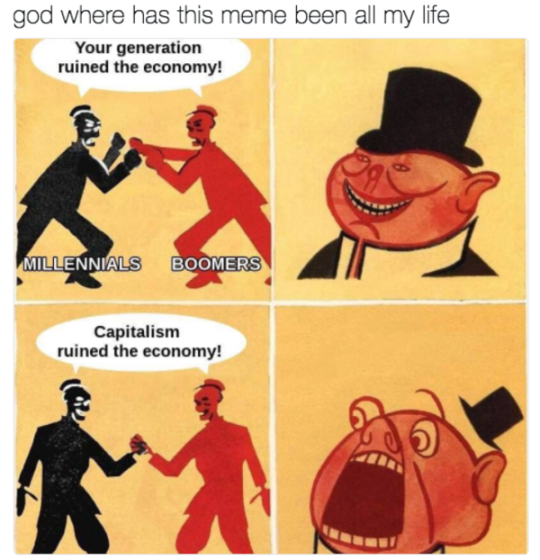
The supposed different “generations” i.e. millennials/Gen X/boomers etc is just liberalism’s attempt to replace class analysis by framing the different generations as coherent classes with different interests. It conveniently fails to mention that there are working class & ruling class people in all generations.
By making all ppl of a certain age responsible for inflation & higher cost of living or w/e, the responsibility of the ruling class is obscured, to the detriment of the working class & to the benefit of the ruling class.
florence’s almsgiving to patti smith in ‘patricia’ is incredible & so in sync with how poetry is changing for me, becoming a thing of gratitude and conversation and the realisation that we make and read things because that’s a space for love to fill, predictable and selfsame and undiluted by its many sources, and we make because we have to, we make each other, we lay ourselves at each other’s feet without pride or shame or resentment over and over and over again we are so vulnerable and so hopeful and that’s how this goes.
Let’s spend today remembering Lou Sullivan, gay trans man, author, and political activist, the stone-cold sumbitch responsible for getting heterosexuality removed as a requirement for medical transition. After testing positive for HIV, he wrote in his diary, “I took a certain pleasure in informing
the gender clinic that even though their program told me I could not
live as a gay man, it looks like I’m going to die like one.”
I think so much depends on a) when you were first exposed to a thing, b) how regularly you have been exposed to it after that first time, and c) whether you’re trying to pretend the thing has no issues.
I mean, you’re really asking two different things here. “Do you think you can enjoy something that was created by a terrible person?” Absolutely. For one thing, we don’t all have a complete Rolodex of Every Bad Thing Anyone Has Ever Done. I have read and watched and loved and treasured things made by people who I later found out were awful; their awfulness clearly did not render the thing completely unenjoyable to the ignorant.
“Can you continue to enjoy something that was created by a terrible person?” Yes, although that takes a little more awareness, I think, of what’s going on, and it’s going to be very, very personal, and very, very situational. Joss Whedon cheated on his wife and abused his power over young actresses and was kind of a terrible person. But Buffy was still incredibly important to me as a teen, and if it comes on the TV, I’ll get through about ten minutes of most* episodes before I forget what I know and only remember what I feel, and what I feel is nostalgia and joy and yes, enjoyment. I don’t get to erase what he did. I will think long and hard before I do things that put more money in his personal pockets. But I can still enjoy some of his work.
(*Most: the episodes that clearly show certain tendencies were hard to watch before I realized how personal they were for him. I can’t deal anymore. I just can’t.)
“Can you enjoy something that has a lot of problematic elements?” Absolutely. Part of this is really going to be when you were first exposed. I know a lot of the things I read, watched, and loved as a kid are super-problematic by today’s standards, and I’m careful to review them before I recommend them to other people, but my love doesn’t necessarily die because I learn more. Obviously, this is subjective: Revenge of the Nerds was absolutely tainted for me by the rapey aspects of the carnival, which went completely over my head as a child, while I can still handle Real Genius despite some of the casual sexism. How problematic is too problematic is completely individual.
“Are you allowed to enjoy something that has problematic elements?” Everything has problematic elements. Everything. If we can’t see them yet, we’ll see them in ten years, and maybe we’ll be horrified, but it will also be a sign that the world is getting better. Are people going to interrogate your enjoyment of certain things? Yeah. There’s a reason my friends who still love Ender’s Game mostly preface that love with “I know OSC is a bigot, but this book was so important to me when I was eleven,” or something of the sort. There’s stuff I don’t discuss enjoying because I don’t want to have the conversation. But unless it’s hurting other people, of course you’re allowed to enjoy it. You get to enjoy anything you want.


 Tsarina Jissa's Tumblr