Doug Jones attends the ‘Star Trek: Discovery’ Press Conference and Red Carpet during Comic-Con International 2018 at Hilton Bayfront on July 20, 2018 in San Diego, California.
For five years, Beck Dorey-Stein was Barack Obama’s “professional stalker,” she says. “His creeper.”
As a former White House stenographer — a job she found on Craigslist of all places — Dorey-Stein was part of a team responsible for going anywhere the president would go, recording his every public utterance and then transcribing it for posterity.
“Especially whenever he spoke with press, he made sure, just like the previous presidents did, that there was a stenographer in the room so that there was no miscommunication or confusion about what exactly was said,” says Dorey-Stein. She writes about the experience in her new memoir, From the Corner of the Oval.
In an interview with Noel King for NPR’s Morning Edition, Dorey-Stein says “everything changed” with the inauguration of President Trump, whose team “didn’t know that stenographers existed.” She recounts how during the transition, it took her boss multiple tries before she was even able to get past a young press wrangler to introduce herself to the incoming West Wing staff.
Things didn’t improve much from there. In a New York Times op-ed published last week, Dorey-Stein writes about how Stephanie Grisham, now the communications director for the first lady, told a colleague that White House stenographers would not be needed often, because “there would be video.”
“This seems like a fair point,” says Dorey-Stein, “unless you really know audio.” The audio that’s taken from media video might change or get trimmed during the editing process, she says. “We see that with music videos, so the idea of it just being like, ‘Oh, of course, we can just have this on video,’ it’s not the same.”
Photo: Saul Loe/AFP/Getty Images Caption: Beck Dorey-Stein, a former White House stenographer, walks with members of the White House press pool from Air Force One upon arrival at Wattay International Airport in Laos on Sept. 7, 2016.
gonna try this format again, because it allows for individual linking instead of everything slapped together into one bigass photo album that you can only vaguely see
aaaanyways, press j to skip the full gallery of buyable shit i’m about to drop here
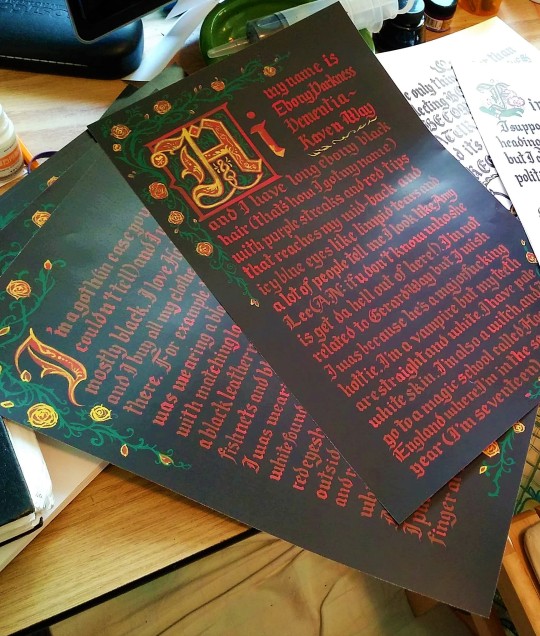
1) My Immortal, aka the worst best fanfiction of all time
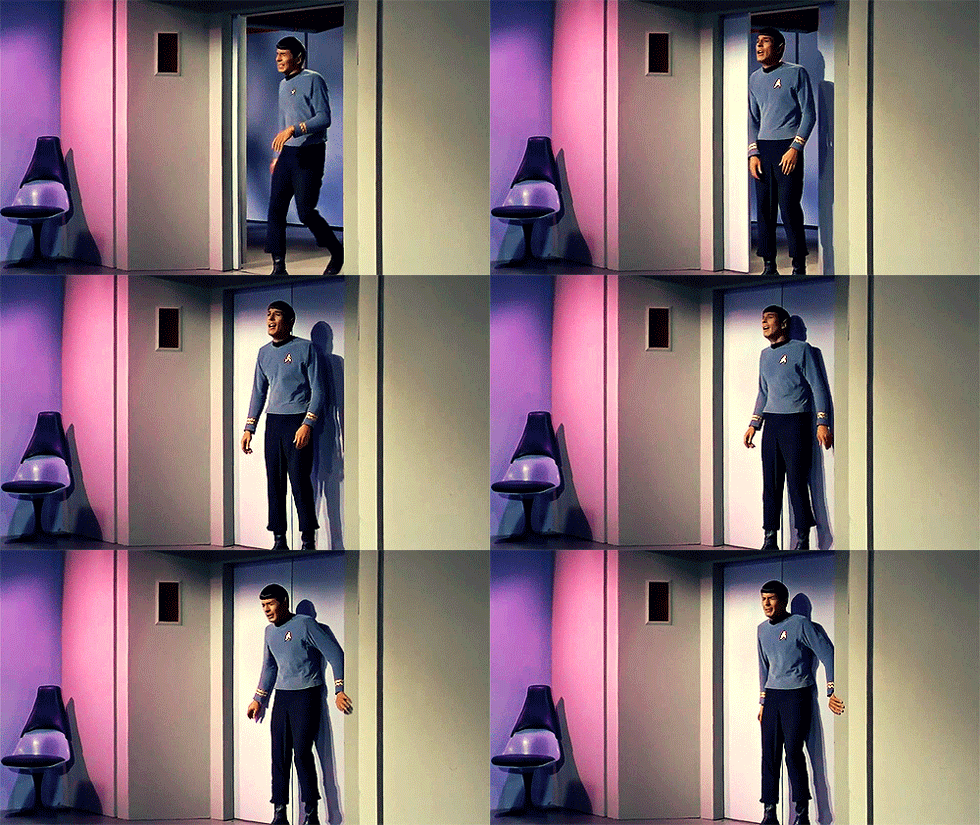
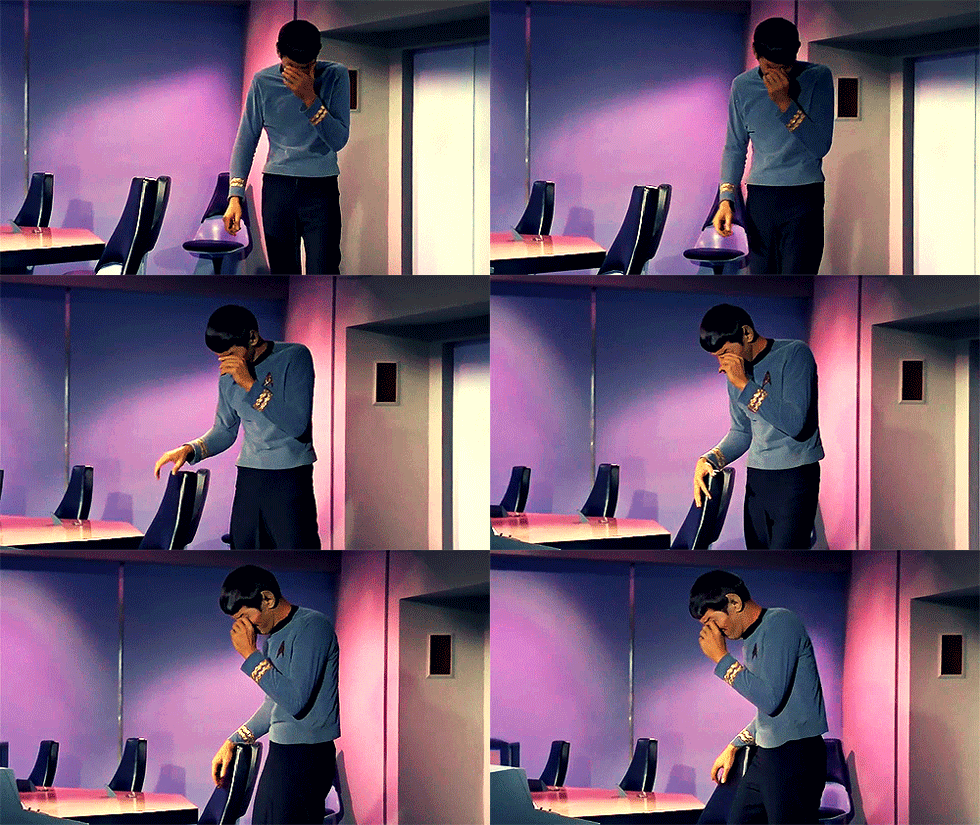
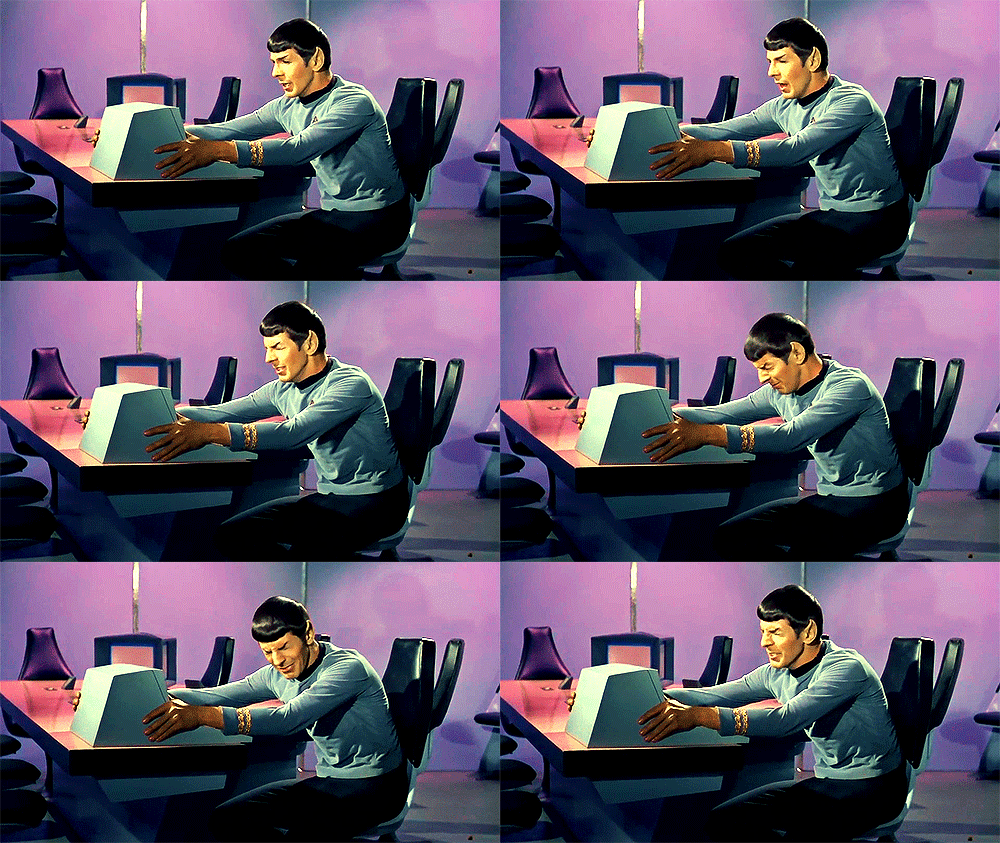
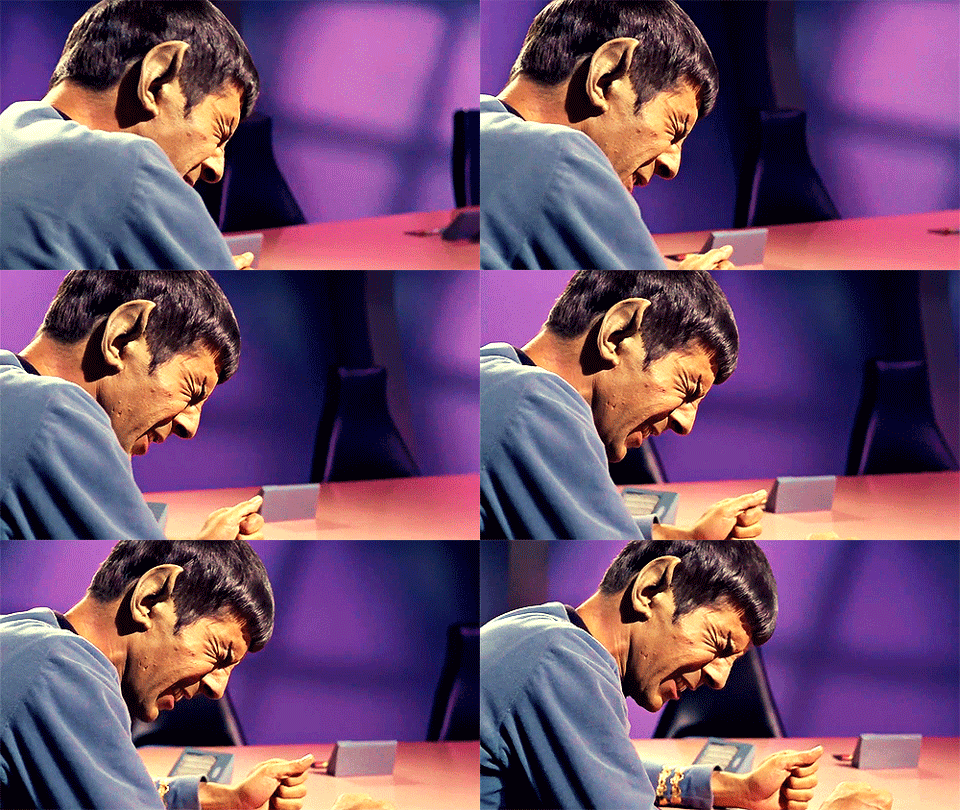
I’m gonna go ahead and be a film snob and talk about why this is one of my favorite shots from TOS. (I could also say that it’s one of my favorite scenes, because the entire scene actually consists of a single shot.)
We don’t see a lot of bald expressions of emotion in film and television, especially if that emotion is fear or sadness or vulnerability. Dramas will give us some tears, but they always cut a way after a few seconds because a closeup of someone crying is deeply uncomfortable and most movies and TV shows aren’t in the business of making their audiences uncomfortable. It just doesn’t sell well.
But in this scene the camera never looks away. It follows Spock as he sits down at the table, and it circles him as he cries. But there are no cuts. We don’t even get music to create some distance, make it all a little more palatable; we just hear sobs and mumbled math equations.
It’s absolutely excrutiating. It would be excruciating no matter who we were watching, because we are so unaccustomed to seeing unadulterated emotion. And then there’s the fact that it’s a man. And that it’s Spock.
Fifty years later and this is still one of the most daring filmmaking decisions I’ve ever seen on TV (I of course can’t be exactly sure who made it, but I’m assuming it was the director of the episode, Marc Daniels). This shot lasts 1 minute and 45 seconds. We’re in the middle of space and in the middle of a high-stakes episode where the crew is going crazy and the ship is going to blow up or some shit and everyone’s lives are in danger, but we pause 1 minute and 45 seconds to have an uncomfortably human moment with an alien who doesn’t even want to be human, and it’s so awful and amazing.
Here is an excerpt from Bill’s Star Trek Memories.
As originally scripted, the scene would have begun with Spock walking down a corridor openly sobbing. At that point, we’d cut away and find that another infected crewman has begun frantically running around the ship, slapping graffiti paint jobs all over the walls of the Enterprise. In subsequent shots, we’d find several more crewmen beginning to lose their inhibitions, and just when the pandemonium is beginning to overwhelm the ship, we’d come back to Spock.
Spock is now riding in an elevator, crying. He gets to his floor, and when the doors open, the graffiti guy runs up and paints a big black mustache on Spock’s face. At that point, Spock cries even louder. Leonard continues:
Now, that’s very imaginative, very inventive, very theatrical and very funny, but I felt that it was not really significant or appropriate for Spock. I mean, Spock was crying… but so what? There was no context for it, no discernible root force, no underlying cause for what’s going on. You know, in a strange way, this one-shot extra who’s walking around doing the paint jobs all over the place is a lot more interesting than Spock, who’s weeping. It seemed to me like we were wasting some really strong dramatic possibilities, all for the sake of an easy sight gag.
So I said all of this to John Black, and I also said that what I felt we really need to do her was a scene in which Spock’s basic inner conflict, the human versus the Vulcan, rises to the surface and motivates his tears. I mean this draft of the script found Spock fighting through all this emotion in public, and I felt that would be a terrible thing for Spock, because he’s a very private person.
So I said to John, “I think Spock would look for privacy when he feels the urge to cry. When he can no longer resist his tears, he would probably look for a private place in which to battle it out within himself.”
And John’s reaction was very negative. It was typical producer/writer-under-pressure kind of stuff. “C’mon, leave it alone because I’m working on next week’s script. Shoot it, just shoot it.” This kind of thing. And he complained about hurting the rhythm of the script.”
I’ve got to break into Leonard’s story here to explain that “it hurts the rhythm of the script” is a sort of basic, all-purpose producer’s excuse that’s fed all too often to actors seeking script changes. Good, bad, legitimate, frivolous, it doesn’t matter. If a producer doesn’t want to deal with your suggestions, he’ll probably just tell you that what you’re suggesting “hurts the rhythm of the script.” It’s the TV producer’s equivalent of “the dog ate my homework,” or “the check is in the mail.” It’s just an easy, somewhat plausible excuse that generally has no basis in reality. With that in mind, Leonard’s determination and fiercely protective nature in regard to Spock drove him over Black’s head to Roddenberry.
I called Gene about it, and I told him just what I’d told John. In talking to Gene, I was very careful to be politically supportive of his producer but about an hour and a half later, here comes John Black out to the set. So now I’m feeling, “Ahh, this great!” I’m feeling that someone’s actually listening to me.
And Black was funny, he cam onto the set and said, “Let’s go talk someplace.” We went to my dressing room, and he said, “Okay, tell me your idea again. Daddy says I have to listen to you.” And I had already formulated a basic concept of the scene, so I said, “Look, John, just get me into a room, and write me a half-page, a quarter-page, where you see Spock walk down a corridor and slip inside a door. As the doors close behind him, he’ll burst into this emotional struggle.” And John asked, “Well, what’s this struggle all about?” And I said, “It’s about love and vulnerability and caring and loss and regret, versus C=pi-r-squared and E=m-C-squared. Spock is a scientist, he is logical, and he feels this can’t be happening to him. It’s that kind of struggle. It’s logic versus emotion. It’s rational control versus uncontrollable urge. With that in mind, going behind closed doors will speak to the basic privacy of the character.”
So John wrote that and some other stuff, six or eight lines maybe, and it was exactly what I needed. Spock was now able to slip inside a door, close it behind him, struggle for a moment, then cry. At this point, he would start babbling, and the cause of the internal struggling would become obvious. Problem was, when it came time to shoot this stuff, a whole new set of obstacles had to be overcome.
Marc Daniels, who was directing this particular episode, came up and asked, “What do you have in mind for this scene?” So, playing director, I said, “Just put the camera here, behind the desk. I’ll come in the door, I’ll walk toward you, I’ll come around, I’ll sit in the chair, and I’ll start this babbling conversation with myself, and I’ll cry. Now, if you’ll dolly around getting closer and closer we can meet at the end of the scene. We can see Spock’s entire breakdown in one long dramatic shot.”
Okay, now it’s five-thirty, I got out to get my ears and makeup touched up, and the time is important because we’re on a very rigid schedule. With overtime being so ridiculously and prohibitively expensive, we’d have to wrap each evening at exactly six-eighteen. Didn’t matter if you were in the middle of a sentence, come six-eighteen, we wrapped.
So now Jerry Finnerman starts to light the scene and it’s obvious that this will be our last shot of the day. I’m in the makeup chair, getting touched up, and now in comes Cliff Ralke, our dolly grip, who was always a very supportive person, and he says, “Excuse me, Leonard, but you’d better get out there, because they’re changing the shot you guys just talked about.”
So now Leonard comes out to the set, and the director has indeed changed the shot they’d just agreed upon. It’s important to note, however, that the reasoning behind this change, though not particularly sensitive to Leonard’s needs, was rational and perfectly valid. You see, as previously discussed, this shot would have entailed a one-hundred-and-eighty degree camera move starting from one side of the set, then slowly dollying completely around to the opposite end. This caused problems because the long, involved shot required a lot of lights and a time-consuming, involved setup that Jerry Finnerman didn’t think could be accomplished without going into overtime. Finnerman discussed this situation with Daniels, and together they decided that the most efficient way to shoot this scene would be in a series of brief cuts, each of which could be lit quickly and with relative ease.
They were going to have Leonard enter in a wide shot, then cut. Next, in a slightly tighter framing, they’d follow him as he crossed the set and sat down. Cut. An even tighter frame would catch the beginning of the speech, and they planned to cut once more, zooming to a close-up as Spock began weeping. This made sense in terms of production efficiency, but Leonard felt this shooting sequence would really damage the dramatic impact of the scene. He continues:
I said, “You’re going to lose the continuity and fluidity of the scene if you shoot it this way. I will not be able to do it as well, and I think the end result will just seem choppy and phony.”
By now it’s five forty-five, and with no time to debate the situation, they got hold Gregg Peters, our first A.D., who was the equivalent of the hatchet man. He was the guy who’d always call the six-eighteen wrap, and we all discussed the situation. Finally Marc Daniels said, “Let’s go for it. Let’s try to get it done.”
Now the lighting crew ran around setting up the shot, and I think it was about six-fifteen when they finally said, “We’re ready.” Marc had me walk through it once, and by now production types were standing around behind the camera, looking at their watches and saying, “He won’t make it. He’ll never do it.” So the tension was really mounting.
So basically I know this has got to be a flawless, one-take thing. Y’know, I’ve got one crack at it before they shut us down for the night. If I were to screw up, we’d almost certainly have gone right back to the cut-and-chop scenario come morning. Anyway, this was the scene that I’d asked for and fought for, and now the logistics of the situation were such that there was absolutely no room for error. There was a lot riding on this, and I wouldn’t have been so adamant in my battling if I hadn’t felt that this scene was extremely important. I felt like it merited my efforts, in that it truly defined, for the very first time, what the Spock character was all about.
Now the lights go on, the cameras roll and we nail it. They get the pan, get the one-hundred-and-eighty-degree dolly shot and the scene was ultimately worked really well in illustrating Spock’s inherent inner conflict. This went directly to the heart of what Gene and I had originally spoken about in regard to the character of Spock. It was an opportunity that I absolutely did not want to miss, and an opportunity to plant a seed in defining a certain edge of the character.
Do you ever think about how there’s probably an online forum for villains that has a password protected thread where they all warn each other not to work with Loki?
“He says he’s interested in your doomsday device, but he isn’t.”
“He kissed me on live TV when I was delivering my threat to the Avengers, but as soon as the cameras were off, he left!”
“He tipped Thor off to our hide-out!”
“He had a playlist key-ed up for Thor’s arrival. The first song was ‘Talk Dirty to Me‘”
“He draped himself across the control panel of my inter-dimensional rift machine and turned it off with his ass.”






 Tsarina Jissa's Tumblr